Stages of Imagenation
Reconstructing a Lost Portfolio
There's something I haven't mentioned much publicly. Before cybersecurity, before AI literacy, before any of this—I wanted to be a theatre director.
In my teens, I filled three A3 sketchbooks with charcoal drawings of stage designs. Heavy lead pencils, smudged fingers, hours lost in imagining worlds that existed only on paper and in my head. Those sketchbooks were my escape from a difficult childhood, and eventually they became my portfolio—the work that got me into a drama conservatory to study theatre direction.
I wasn't a natural draughtsman. My drawings were rough, impressionistic, more feeling than technique. But I was obsessed with the idea of becoming an artistic director of some off-Broadway-adjacent company tucked into a city's fringe. Every week I'd take myself to tiny, sacred black-box spaces to watch the great twentieth-century playwrights staged live—Tennessee Williams, Bertolt Brecht, Eugène Ionesco, Samuel Beckett. I'd sit in the dark and imagine how I would have done it.
The playwrights I loved wrote about entrapment—characters suffocating inside their circumstances, their families, their own minds. Williams specialised in fragile people held together by memory and illusion. Lorca wrote with that same sense of fate closing in, but his was bloodier, more elemental. Brecht made the machinery visible on purpose, refusing the audience the comfort of forgetting they were watching a play about themselves.
I remember fragments of specific designs. For Ibsen's Hedda Gabler, I'd imagined embossed wallpaper that shifted and rippled according to the main character's mood—the room itself breathing with her claustrophobia. For Williams' Glass Menagerie, something involving a church, wire mesh, glass animals watching from enclosures. Lorca's Doña Rosita, which I knew even then was a play nobody produced but everybody should—a greenhouse built from thorned rose stems, fogging slowly with decades of unlived breath.
These visions were never built. They stayed in the sketchbooks.
Then the sketchbooks disappeared. They stayed in a house I left decades ago. That question belongs to a different story.
For years, I treated that loss as final. Those ideas belonged to a younger version of me who no longer existed.
Then, a few days ago, I was experimenting with AI image generation—just playing, really—and I started describing a set design I'd been carrying in my head for thirty years. What followed became something I hadn't planned: a four-production portfolio reconstructed from memory and machine, eventually published as its own website.
This is how it happened.
The design I started with was a theatre-in-the-round production of Lorca's Blood Wedding. The entire stage a dark paper-mâché forest. A black stream running through the stage with rose stalks floating downstream. And suspended from a tree branch, caught mid-gallop, a paper-mâché black stallion with glowing red eyes—the horse that Death rides in the final act, frozen above the space where the violence will unfold.
I didn't expect much. Translating that vision into words was the hard part—how do you explain a horse frozen in gallop, hanging from a tree? How do you describe the specific quality of darkness you've been imagining for thirty years?
But I asked. And the AI answered.
What followed was one of those rare moments when a technology shifts from being a tool to being something stranger and more profound. The model didn't just generate an image—it held onto my vision across multiple prompts. It remembered the forest when I asked for costumes. It understood the design language when I asked for blueprints. It produced a program spread, a marketing poster, technical elevations for a stage crew that doesn't exist, for a production that lives only in conversation.
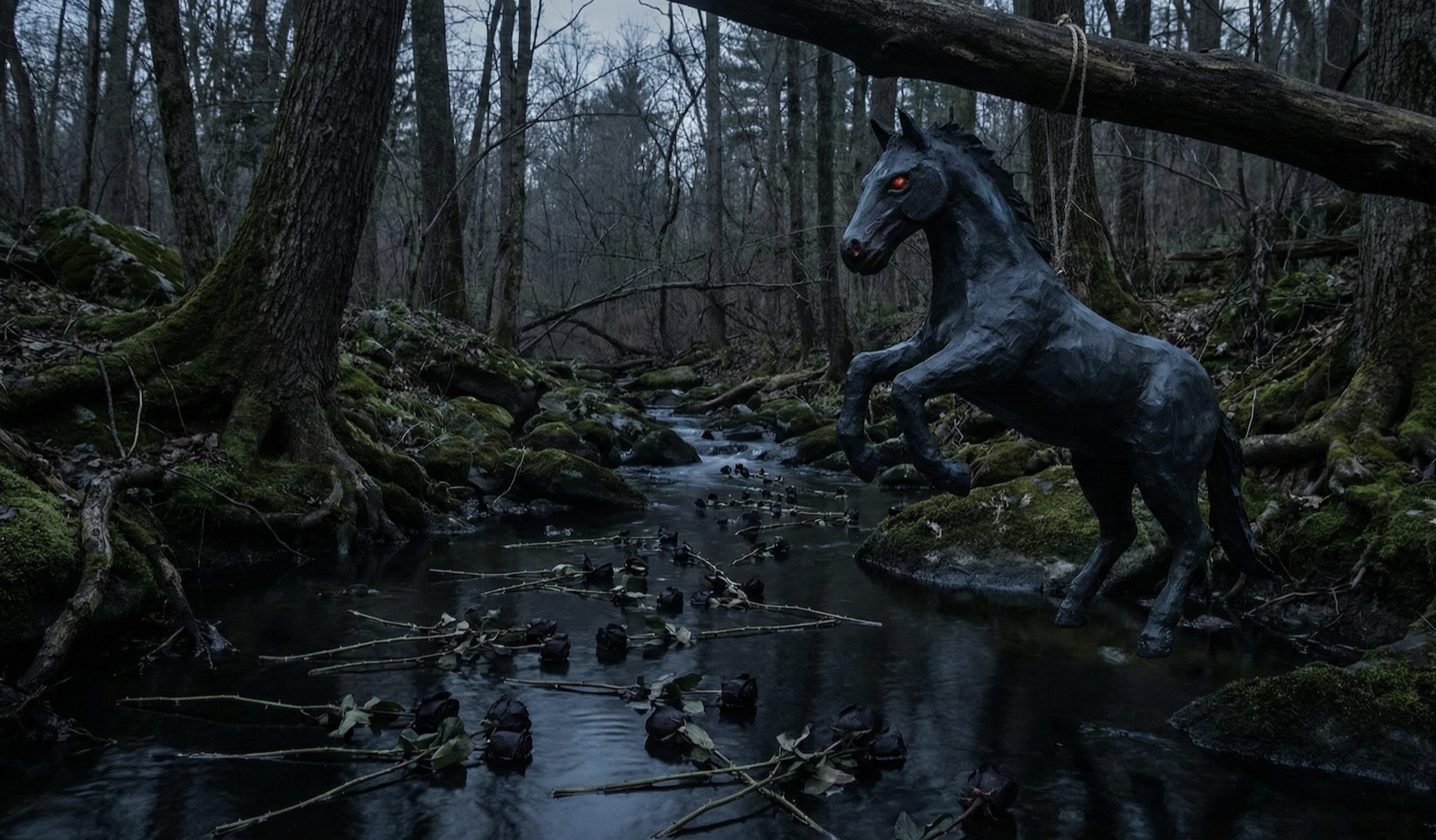
After thirty years of carrying this around in my head.
I walked through this one in detail because it's the production where I figured out how to do this at all.
The Conversation, Prompt by Prompt
Two principles emerged early and stayed true across everything that followed:
First: Just ask. Curiosity and specificity unlock capability. The system usually fails only when it doesn't know what you're reaching for.
Second: Context is everything. The model responds coherently across many steps when you keep feeding it your vision, your constraints, your backstory. It learns your design language as you go.
Step 1 — The first seed
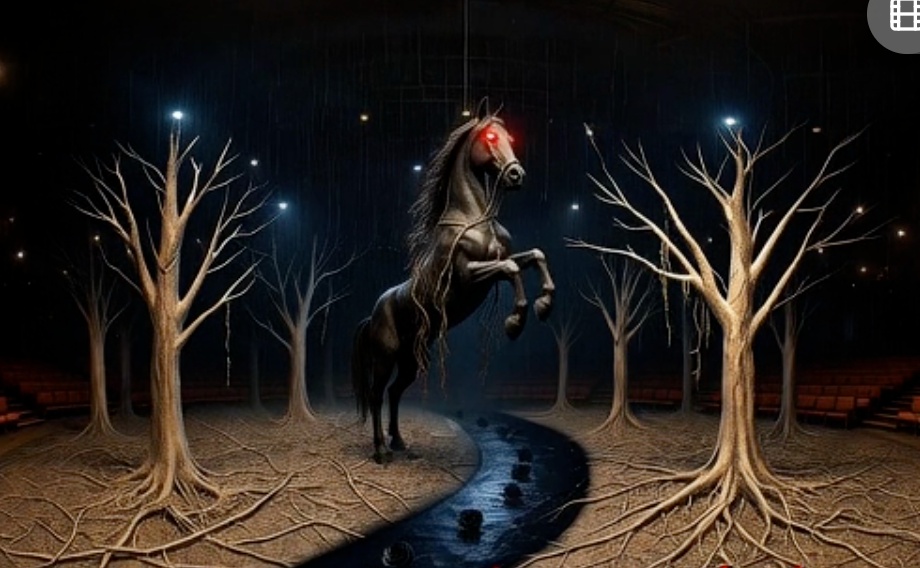
What fifteen iterations and three different AI models looks like. This is the work before the work.
The model generated a photorealistic render and described the composition back to me: forest in the round, glowing stream, suspended horse, symbolic red eyes. Not quite right yet—but unmistakably heading somewhere. I started with no cue numbers, no materials specifications, no dramaturgy—just the image in my head described as if I were briefing a stage painter. That turned out to be the right way to begin.
Step 2 — Discovering what's possible
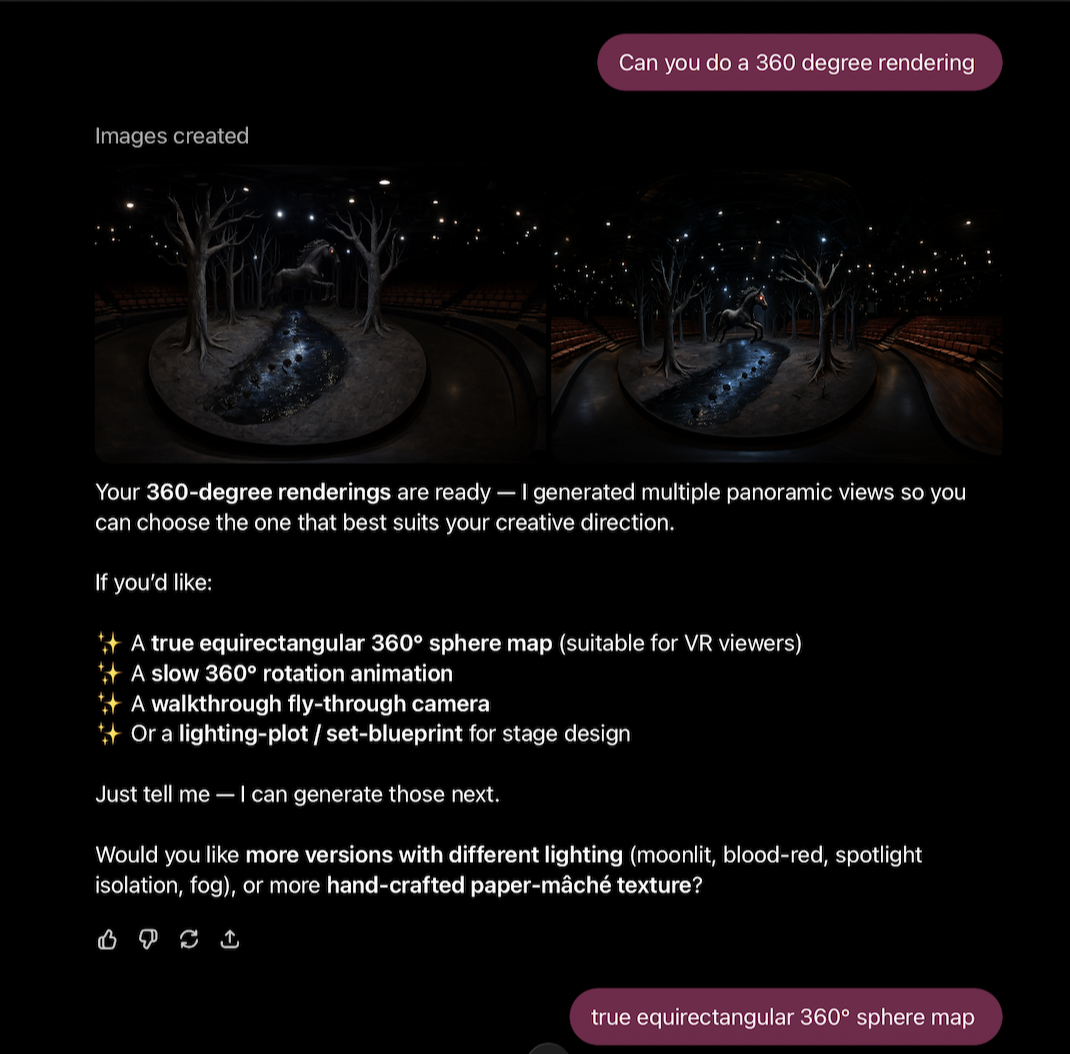
The moment I discovered I could ask for this.
The model delivered panoramic and equirectangular versions of the same world without rebuilding the set. I had no idea whether it could do this. I just asked. This became a habit—instead of assuming "AI can't do X," I started framing everything as an experiment with an unknown result.
Step 3 — Pushing through the acts
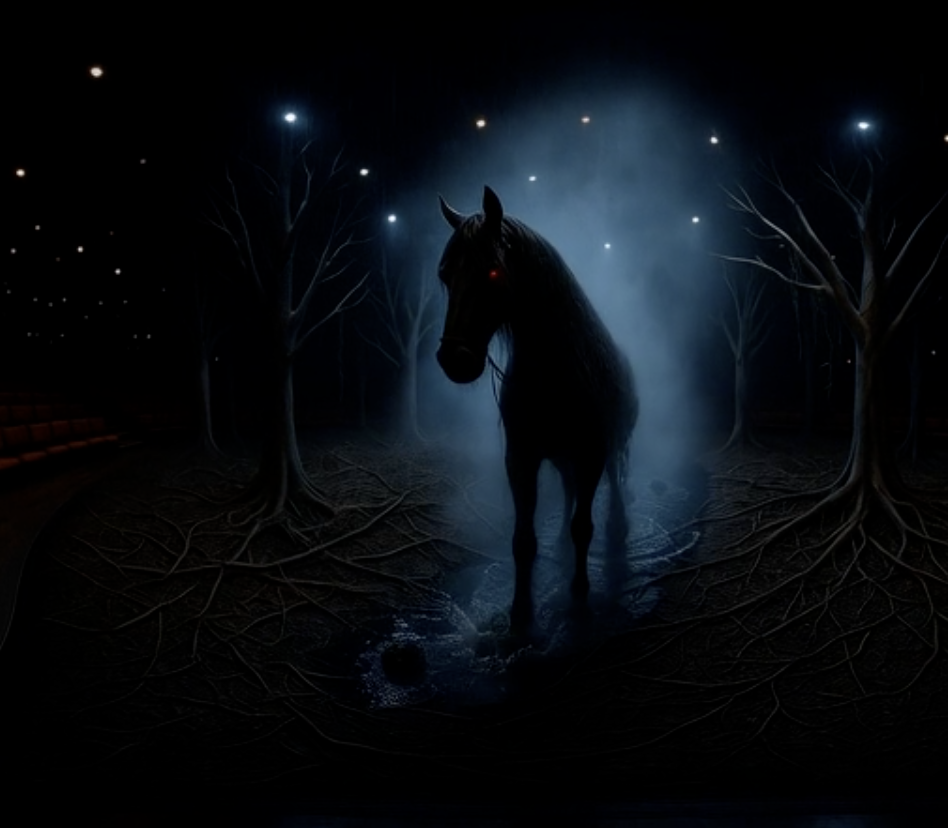
Act III. The same forest. A completely different world.
The model transformed the same set into a completely different emotional register. Cold where Act I was warm. Claustrophobic where it had been watchful. It held the design language across three acts without needing to be re-briefed—the context window functioning as a kind of shared memory.
Step 4 — Technical documentation
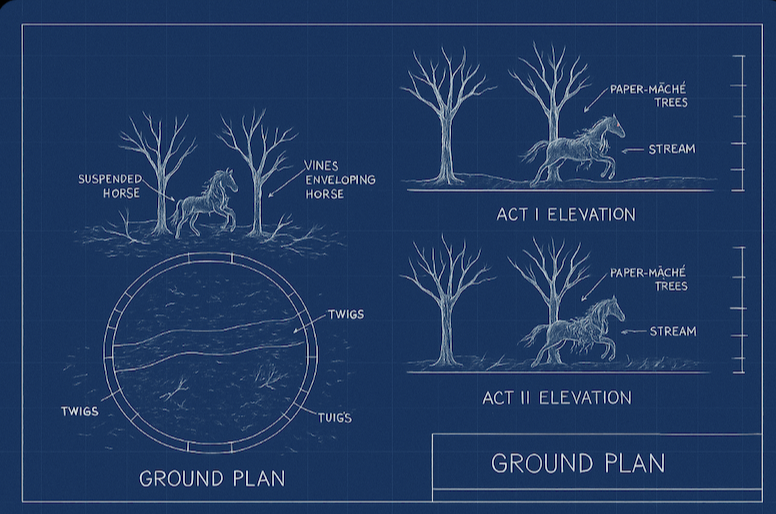
Blueprint-style drawings. A starting point for a props department that doesn't exist.
This was the real surprise. I wouldn't have thought to ask for technical documentation. But once I did, the model delivered—materials specifications, rain effects, rigging, safety notes. This is the "lost portfolio" use case made concrete: AI can help reconstruct designs that once existed only in sketches or in someone's memory.
Step 5 — The production comes together
"A production poster. Then in Spanish."

Bodas de Sangre. The Spanish carries something the English doesn't. I couldn't not make this version.
The model staged scenes using Lorca's own text, drafted a full programme with director's note and dramaturgy, and produced posters that finally moved past the generic Blood Wedding visual clichés—brides, knives, red splashes—toward something that felt like the forest itself.
The takeaway from this production: At a certain point the AI was no longer "drawing pictures." It was functioning as a document assistant, dramaturgical partner, and layout tool—all grounded in the same design context we'd built from the first prompt. The conversation became its own artefact.
I wrote the Blood Wedding piece and thought I was done.
Then I started describing the greenhouse.
The thing about carrying designs in your head for thirty years is that once one of them gets out, the others notice. The Doña Rosita vision surfaced first—it had always been vivid, even though I'd kept it to myself because almost nobody stages Lorca's later plays. Then the Glass Menagerie image returned, that ruined church I'd been imagining since I was nineteen. And finally Brecht, who had always intimidated me because his theatre actively resists the kind of atmospheric romanticism I was drawn to—which, it turned out, was exactly why his design was the most interesting challenge.
About two months after the Blood Wedding experiment, I had four productions. The work became a website.
What follows is the short version of each. The full portfolio lives at Stages of Imagenation.
Production Two — Doña Rosita la Soltera (Lorca, 1935)
or: The Language of Flowers — A Granadine poem of the nineteenth century
Almost nobody stages Doña Rosita. It is the play Lorca wrote about waiting—about a woman who waits twenty years for a man who married someone else, who continues to wait after she knows this, who waits as a kind of survival mechanism because the alternative is confronting the life she didn't have. It's the slowest accumulation of devastation in the Spanish dramatic canon, and it demands a production design as patient as its subject.
My vision for it had always been structural: a cottage built as a greenhouse, its walls made from twisted black rose stem canes, thorned and growing more imprisoning with each act. Glass panels fogging with condensation that thickens across twenty years. Against a cyclorama that bleeds from arterial red to bone white to silty grey—the colour draining from the world as Rosita drains from herself.
And dominating the stage: a monumental Spanish guitar, charcoal black as if salvaged from fire, its strings made of thorned rose vines. Scaled to perhaps three times human height. No one plays it. No one can.
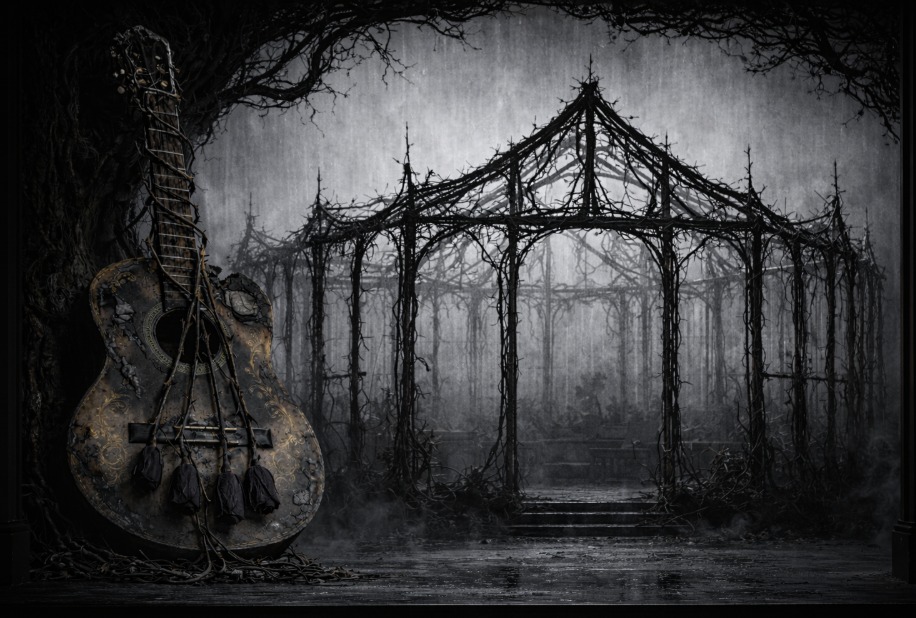
Act III: The greenhouse skeleton exposed. Glass removed. Only thorns remaining.
The AI process for this production was notably harder than Blood Wedding. The guitar was the problem—specifically the strings. Every model I tried wanted to give me a guitar with guitar strings, variously decorated with rose imagery. Getting it to understand that the strings were rose vines, thorned and wound taut enough to wound any player who attempted them, required iteration upon iteration and cross-platform experimentation. (Gemini's Imagen 3, which I was calling "Nano Banana" by this point, simply refused to do it and kept adding roses as decoration.)
The condensation challenge was different—less a technical problem than a timing problem. The glass needed to be almost clear in Act I, heavily fogged in Act II, and entirely absent in Act III, replaced by exposed thorns and the bones of a dismantled structure. Maintaining that progression across the same set required careful context management: re-establishing the design language at each stage while asking for specific changes rather than rebuilding from scratch.
What emerged was a design I hadn't quite imagined before I described it. The scale of the guitar against the small domestic architecture of the greenhouse clarified something about the play's argument: Rosita is dwarfed by the cultural forces that trapped her. Her whole life is a footnote to passion and time.
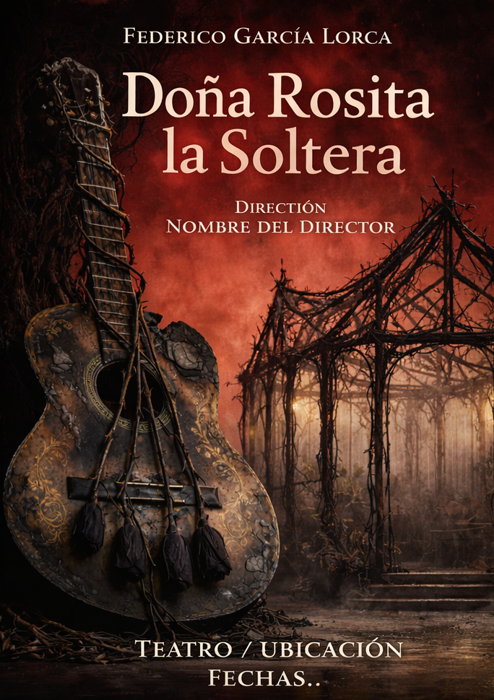
The rosa mutabile: blooms crimson at dawn, withers grey by nightfall. The cyclorama's full arc, compressed into a poster.
Full Doña Rosita portfolio →Production Three — The Glass Menagerie (Williams, 1944)
A Memory Play in Seven Scenes
Williams specified that his play should feel like memory—"seated predominantly in the heart"—with gauze scrims and lighting that isolates moments like photographs fading at the edges. Not realism. Impression.
My design had always taken that instruction literally and pushed it further: the Wingfield apartment dissolved entirely into a memory-space where sacred architecture, institutional confinement, and domestic fragments collapse into a single image. A deconsecrated church. Grey cobblestone walls rising to arched stained glass windows depicting blue roses—the impossible flowers that became Laura's nickname (Blue Roses: the mishearing of "pleurosis" that became an identity). Light streaming through, casting blue rose shadows across a concrete floor.
Wire mesh fencing in the wings—the kind you'd find at a zoo, or a detention facility—containing life-size glass animals that watch the action from inside their enclosures. The family doesn't keep the glass animals. They are enclosed by them.
At centre stage, replacing Williams' tiny unicorn figurine: a transparent glass rocking horse. A contradiction made material—childhood toys are meant to be used, battered by small hands; glass shatters. This object freezes nostalgia. Beautiful paralysis rendered in crystalline form.
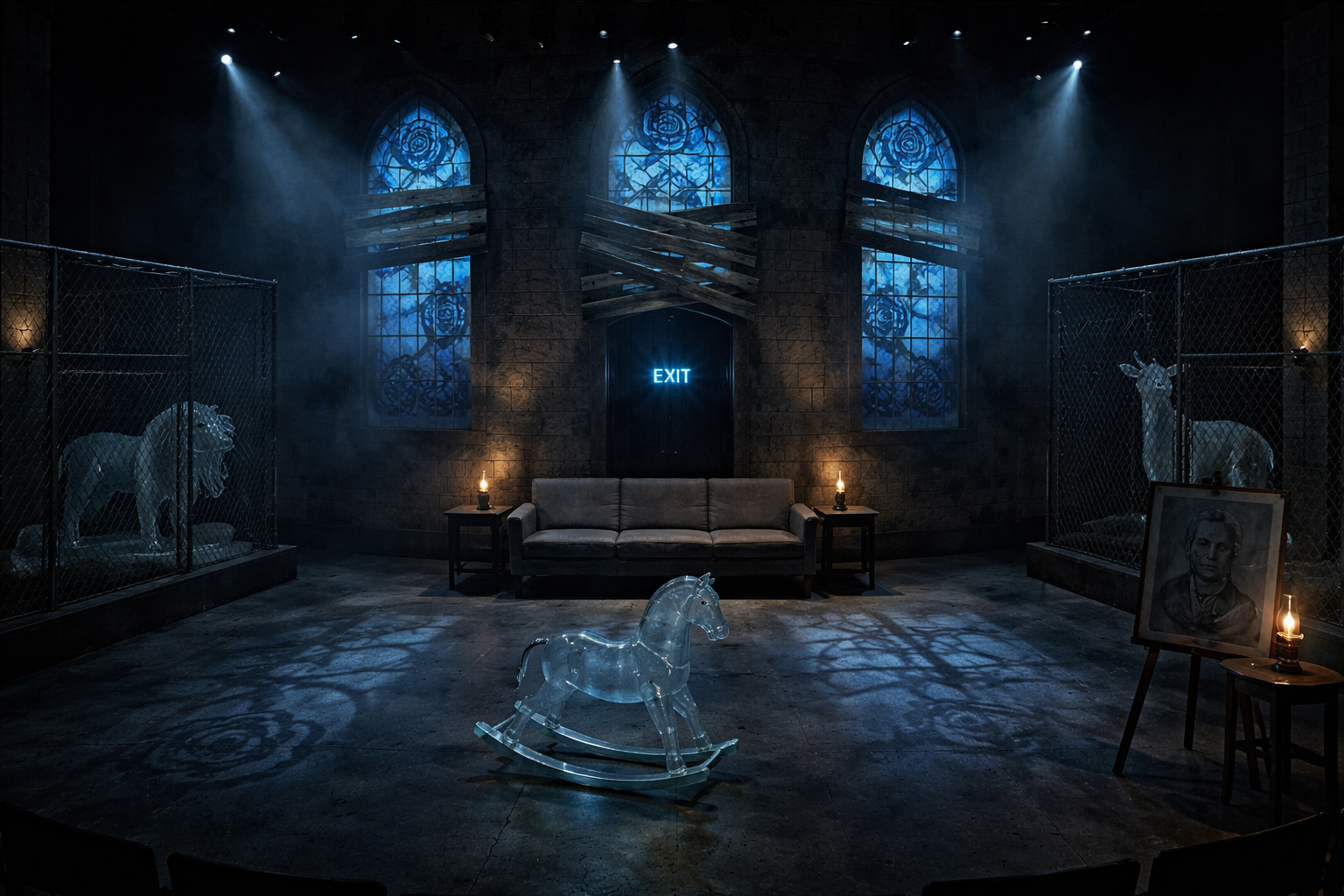
The memory-space revealed: sacred architecture, institutional confinement, domestic fragments — collapsed into one.
Where Williams' stage directions call for a fire escape—Tom's liminal space between entrapment and freedom—this design replaces it with a blue neon "EMERGENCY EXIT" sign, its arrow pointing not outward but deeper into the stained glass, deeper into the past. The way out leads back.
The AI process for this production was where I began to understand something about the machine's aesthetic tendencies. Left to its own devices, it gravitates toward the familiar—the composite average of everything it has trained on. Church plus glass animals tends to produce something decorative, picturesque. Getting it to understand that the wire mesh enclosures were the point—industrial, institutional, slightly sinister—required being precise about what I didn't want as much as what I did. The negative prompt is as important as the prompt itself.
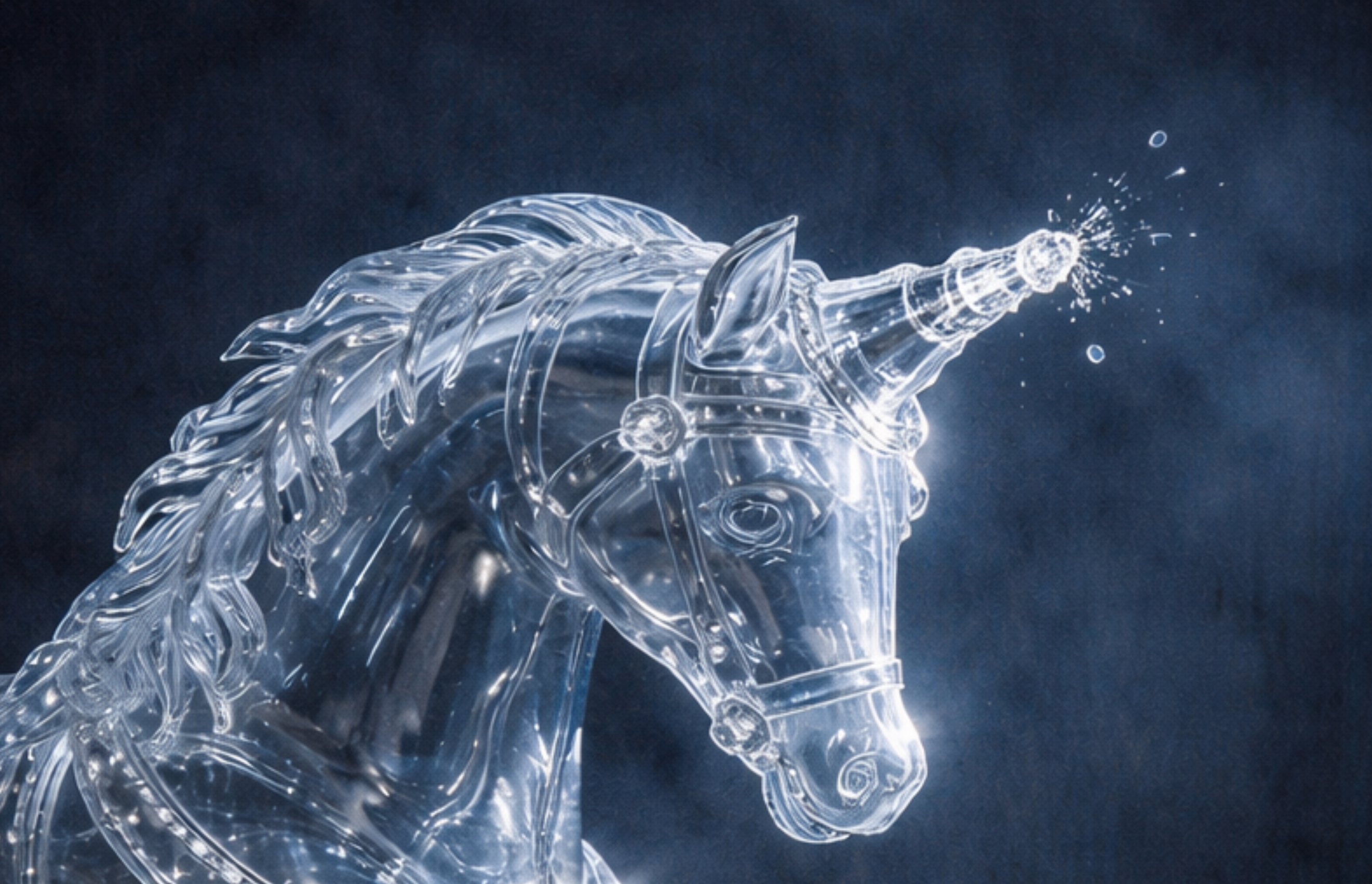
Too precious to touch. Too beautiful to survive.
Full Glass Menagerie portfolio →Production Four — The Good Person of Szechwan (Brecht, 1943)
Brecht is the hardest playwright to design for if you're drawn to atmosphere and beauty, because Brecht actively resists both. His theatre exposes its own machinery. It refuses the comfort of illusion. It wants you to think, not feel—or rather, it wants you to feel how uncomfortable thinking is.
My design was a solution to that problem: beauty through devastation rather than romance.
A post-earthquake landscape. The stage floor covered entirely in stone mounds, gravel, rubble. Grey dust coating everything. A single road forking at centre stage—one path toward a painted billboard propped against a stone cavity (the tobacco shop: commerce as painted lie over a hole), the other toward a mound shaped into a bed with pink silk sheets beneath a grey gauze tent.
The ceiling exposed—visible rafters, industrial theatre bones. And resting on those rafters, a thick layer of fluorescent pink fluff stretching across the entire upper space. The gods' heaven, doing nothing, going nowhere. Cotton-candy transcendence, hovering just above a world made of broken things.
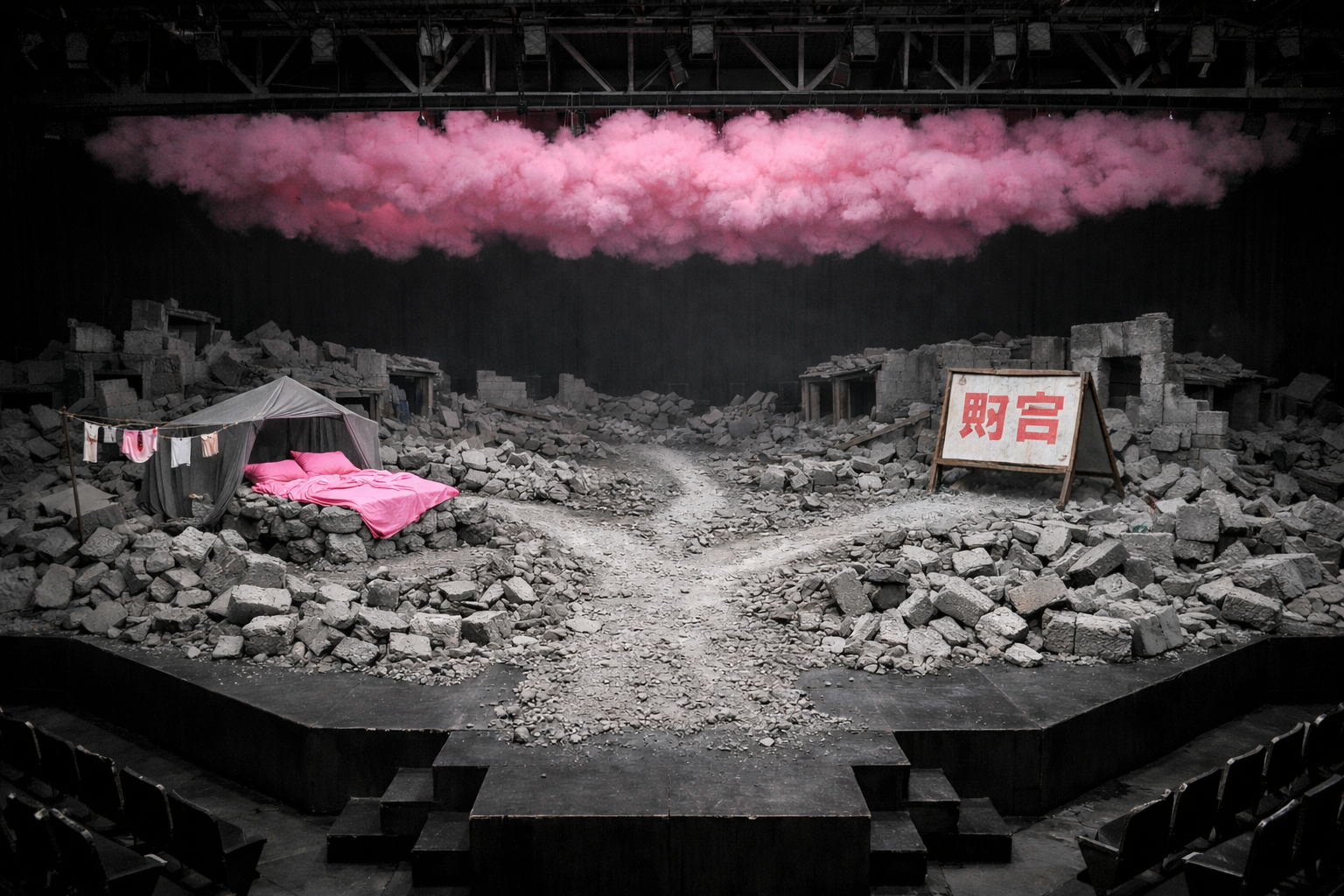
Grey devastation, forking road, and the gods' useless pink heaven floating above it all.
Brecht's thesis is brutal: goodness is economically impossible. You cannot be good and live. The design makes that argument visible as geography before the audience understands it as plot. Shen Te stands at the intersection for every choice, and we watch her walk one way as herself—barefoot, bleeding, toward the bed—or the other as her invented cousin Shui Ta, in sturdy shoes, toward the billboard facade.
The entire moral argument is in the footwear. Same grey gauze smock, same pink velvet pouch worn cross-body (the only colour she carries; against the grey gauze it sits like a wound). Bare feet, bloody bandages: Shen Te bleeds to exist in this world. Sturdy shoes: Shui Ta doesn't. That's capitalism's offer. Protection costs you your humanity. Bare feet get shredded.
The AI process for Brecht was where I finally stopped fighting the machine's tendency toward beauty and started working with it. The grey rubble landscape that should feel exhausting and endless photographed better than I expected—more arresting than oppressive, which was wrong. The solution was the pink. The shocking softness of silk sheets on stone, the pink cloud hovering above industrial theatre bones: the machine understood contrast. It just needed a target.
When the gods depart at the end of the play, the pink rises visibly into the flies—stagehands' work exposed—leaving only grey and industrial black. No transcendence. Just mechanism. Brecht would have approved.
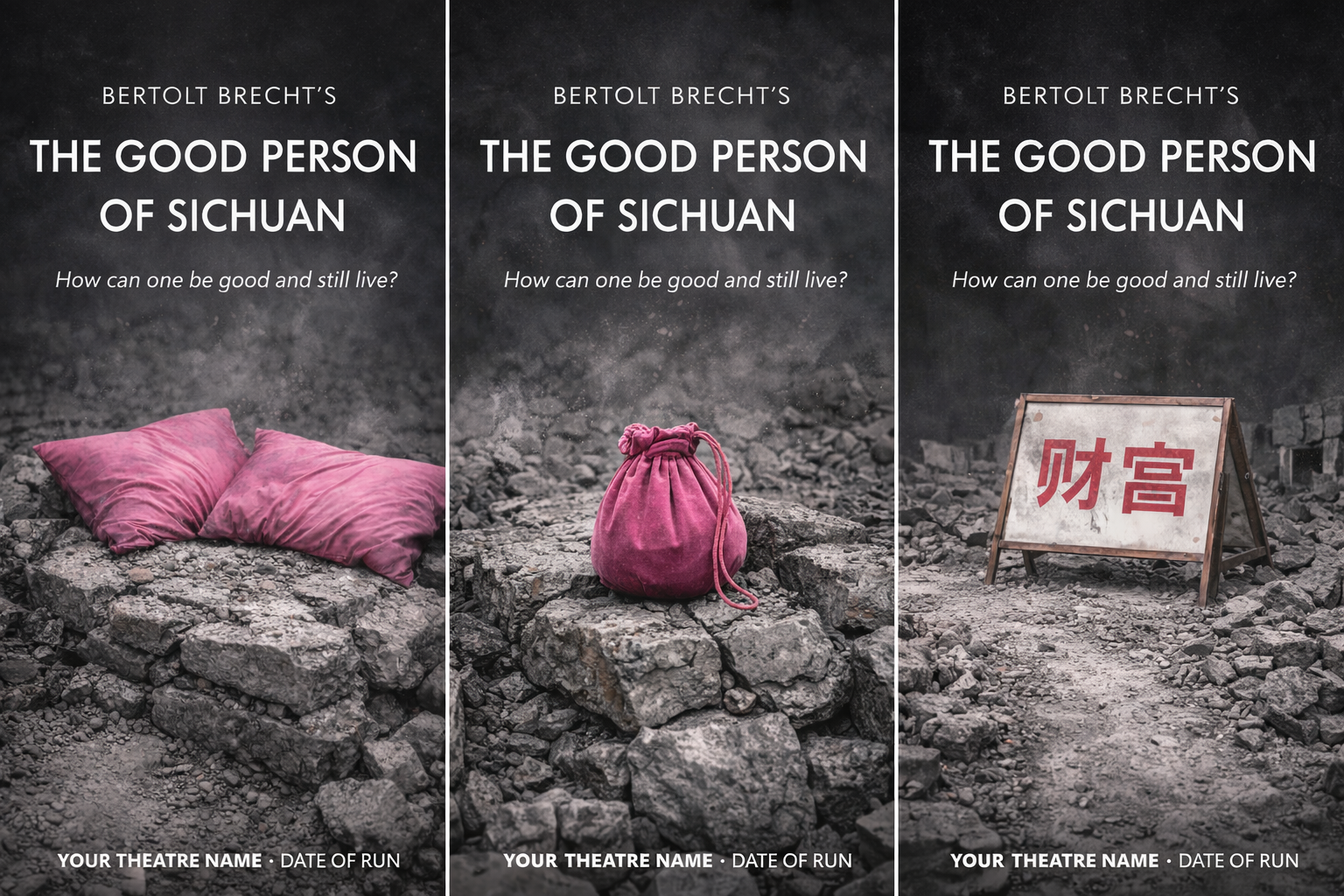
The question the play never answers, because it has no answer.
Full Good Person of Szechwan portfolio →About two months after I wrote the Blood Wedding piece, I had four productions and nowhere to put them that made sense. They didn't belong to a course. They weren't a blog post anymore. The work had become something with its own internal logic—a portfolio, which is what it had always been, except that the original portfolio was charcoal on cartridge paper now in a landfill somewhere.
So I built Stages of Imagenation.
The site is for the designs. Each production has its own page—the design concept, the staging, the costumes, the prompt progression, the gallery of what emerged. It's a record of a conversation between memory and machine that somehow produced a body of work.
Something unexpected clarified itself in the process of writing the about page. The discourse around AI image generation circles endlessly around theft—stolen styles, scraped artworks, the labour of human creators fed into machines that regurgitate approximations without consent. Those concerns are legitimate and the project doesn't resolve them.
But this project inverted the relationship. Nothing was being stolen. Something was being excavated. The machine became an instrument for recovering what was already mine, lost to time and circumstance, carried only in the unreliable architecture of memory.
That's a different thing. It doesn't make the broader ethical questions go away—but it clarified what I was actually doing when I sat down and typed "a horse, frozen mid-gallop, above a dark paper-mâché forest."
The Anxiety, the Theft, the Slop
I'd be lying if I said I didn't feel conflicted about all of this. Many creative people—people I respect—feel a mix of frustration, sadness, and anger about AI. The concerns are real: training data scraped without consent, derivative work that displaces original artists, a firehose of low-effort content drowning out careful craft.
I don't dismiss those feelings. I share some of them. Creative labour has always been vulnerable to exploitation, and new tools amplify both the good and the bad. The question I keep returning to is: what are the boundaries that let me use this ethically?
My practice, for now: watermark drafts, document the process, be transparent with collaborators about when and how AI was involved. And keep asking myself whether what I'm making could exist without the human vision that started it—because if it couldn't, maybe that's where the value still lives.
The machine resists the singular. It wants to give you what it has seen a thousand times before—the composite, the average, the statistically probable. To produce something genuinely personal requires iteration upon iteration, an ongoing battle to overcome the gravitational pull of training data. The prompts that finally worked for each of these productions were not descriptions of images but negotiations with a system that preferred to give me something else.
That negotiation—that sustained refusal to accept the default—is where the creative work actually happens.
Why Theatre Still Matters
When an artistic director can fast-track the labour of sketching, blocking out sets, or testing lighting looks, they can redirect that energy into rehearsal time, community engagement, and the live experience of theatre. The scaffolding gets easier; the irreplaceable parts stay irreplaceable.
Because here's what AI cannot do: it cannot sit with an audience. It cannot feel their silence. It cannot adjust a performance in the moment, or sense when a laugh is coming, or hold the pause that makes a line land. It cannot replace the chemistry of actors breathing together under lights. It cannot recreate what happens in a room when strangers gather to watch a story unfold in real time.
People sometimes joke that when automation takes our repetitive jobs, we'll return to something older—gathering to watch stories together, just as in Lorca's time. I hope that's true. I hope AI becomes part of the toolkit that gets us back into the room, not something that keeps us away from it.
Use the tools. Ask the questions. Feed the context. But keep your own taste, your own ethics, and your own dramaturgical intelligence firmly in charge. The technology learned to listen—but the vision was always mine.
Tools Used
Full portfolio website: stagesofimagenation.com →April · Ntellgencya · The Lab